



A Comprehensive Legal Analysis under Central Bank Circular No. 9/2025
The Central Bank of the United Arab Emirates has introduced a significantly strengthened regulatory framework governing dormant accounts and unclaimed funds through Circular No. 9/2025 dated 10 November 2025. This Regulation replaces the earlier Dormant Accounts Regulation and is issued pursuant to Federal Decree-Law No. (6) of 2025 concerning the Central Bank, Regulation of Financial Institutions and Activities, and Insurance Business. The new framework represents a major compliance milestone for Licensed Financial Institutions (LFIs) and substantially enhances consumer protection by ensuring long-term safeguarding of dormant and unclaimed balances.
Scope and Objective of the Regulation
The Regulation applies to all Licensed Financial Institutions, including banks, insurance companies, and exchange businesses operating in the UAE. Its principal objective is to establish a unified and enforceable framework for identifying, managing, reporting, transferring, and reclaiming dormant accounts and unclaimed balances, while ensuring that ownership rights of customers and their legal heirs remain fully protected. The Central Bank retains the authority to impose additional compliance requirements where deemed necessary.
Meaning and Classification of Dormant Accounts
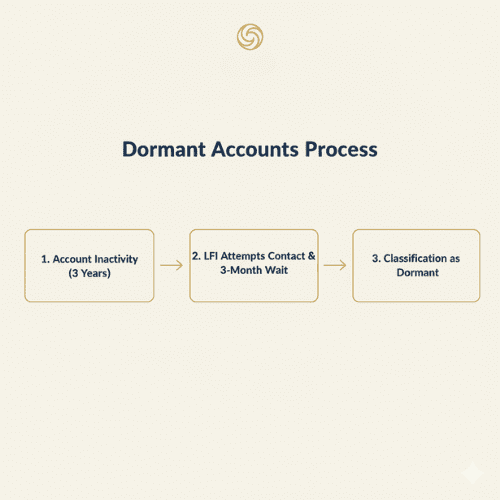
Dormancy is determined at the customer level rather than at the individual account level. A customer is classified as dormant when all liability accounts, balances, or insurance benefits held with an LFI remain inactive for a continuous period of three years and the customer cannot be contacted through available channels.
Savings, call, and current accounts become dormant after three years of inactivity. Fixed-term deposits become dormant three years after maturity if no renewal or claim has been made. Insurance claims, refunds, and unclaimed insurance pool funds also become unclaimed after three years if the beneficiary cannot be located.
Joint accounts are treated as separate legal customer identities and do not affect dormancy status of individual accounts of joint holders. Asset-based investment accounts are excluded from dormancy classification.
Obligations of Financial Institutions upon Dormancy
Once an account or balance is identified as dormant, the LFI must initiate communication attempts through written, electronic, and recorded verbal channels to locate the customer or beneficiary. A final notice must be issued, and a mandatory three-month waiting period must be observed before transferring balances into internal dormant and unclaimed funds ledgers.
Safe deposit boxes require judicial supervision before opening or disposal of contents. LFIs must implement enhanced internal controls, restrict access to dormant accounts, segregate customer documents under dual control, and prevent unauthorized operations.
Reporting and Regulatory Oversight
LFIs are required to submit quarterly detailed reports of all dormant and unclaimed balances transferred, including details of opened safe deposit boxes, to the Central Bank. Separate reporting frameworks apply to banks, exchange businesses, and insurance companies. These requirements significantly strengthen regulatory transparency and oversight.
Transfer of Dormant Balances to the Central Bank
If accounts remain dormant for five years, or if bankers’ cheques, drafts, cashier orders, insurance claims, and exchange business balances remain unclaimed for the statutory period, LFIs must transfer the net balances to designated unclaimed balances accounts maintained by the Central Bank.
All balances must be transferred irrespective of amount. Foreign currency balances are converted into UAE Dirhams at prevailing customer rates prior to transfer. Following transfer, dormant accounts must be closed, while digital records must be preserved indefinitely.

Rights of Customers and Legal Heirs
Dormant funds remain the legal property of the customer or their legal heirs. Interest continues to accrue on interest-bearing accounts until transfer to the Central Bank. No charges may be applied after dormancy classification.
Customers or heirs may reclaim funds through the original LFI by submitting identity and legal documentation, after which the LFI will arrange withdrawal from the Central Bank and effect payment to the claimant.
Consumer Protection and Compliance Risks
LFIs are strictly prohibited from recognizing unclaimed funds as income. Dormant accounts are subject to enhanced monitoring to prevent fraud, misuse, or money laundering. Financial institutions must transparently disclose dormancy conditions within account opening terms, insurance policies, and exchange transaction documentation.
Sanctions and Legal Effect
The Central Bank may impose supervisory actions and administrative sanctions for any violations. Circular No. 9/2025 repeals and replaces earlier dormant account regulations and is now the sole binding framework governing dormant accounts and unclaimed funds in the UAE.
Conclusion
The Dormant Accounts and Unclaimed Funds Regulation 2025 represents a fundamental compliance reform in the UAE financial sector. It establishes a high-integrity custodial regime, strengthens consumer rights, enhances judicial safeguards, and introduces strict accountability mechanisms for financial institutions. Compliance is now a core regulatory obligation carrying significant supervisory and enforcement implications.
If you require further clarification or legal assistance concerning the matters discussed in this article, please do not hesitate to contact Khairallah Advocates & Legal Consultants LLC. Our lawyers would be happy to assist you.
Authors:


KH Legal’s corporate and commercial lawyers in the UAE advise businesses on structuring, contracts and governance.
Frequently Asked Questions About Dormant Accounts in the UAE
When does a bank account become dormant in the UAE?
In broad terms, an account is classified as dormant when there have been no customer-initiated transactions or contact for the period set by the Central Bank’s dormant accounts framework — historically three years — and the bank cannot reach the customer through its normal channels. Circular No. 9/2025 tightens how Licensed Financial Institutions must identify, flag and manage such accounts.
Is money in a dormant account lost or confiscated?
No. Dormancy changes how the funds are safeguarded, not who owns them. Balances that remain unclaimed are ultimately transferred to the Central Bank of the UAE for safekeeping under the Regulation, and the customer — or their legal heirs — retain the right to claim them at any time.
How do I reclaim funds from a dormant account in the UAE?
Start with your bank: present valid identification and proof of entitlement, and the bank will verify your identity, reactivate the account or arrange payment. If the balance has already been transferred to the Central Bank as unclaimed funds, the bank remains your point of contact and must facilitate the claim process on your behalf.
Can banks keep charging fees on dormant accounts?
The regulatory framework restricts what institutions may charge once an account is classified as dormant, precisely so that unclaimed balances are not eroded by ongoing fees. If you find significant charges accumulated during dormancy, that is worth reviewing with a lawyer or raising through the Central Bank’s consumer protection channels.
What happens to unclaimed cheques, deposits and insurance amounts?
The framework is not limited to current and savings accounts — categories of unclaimed funds such as unpresented banker’s cheques, matured fixed deposits and certain unclaimed insurance amounts are also captured, with institutions required to safeguard and eventually transfer them under the same principles.
Can heirs claim a deceased relative’s dormant account?
Yes. Heirs can claim dormant balances by presenting a succession certificate or court order establishing their entitlement, together with identification documents. The process runs through the institution holding the account, and legal assistance can significantly speed up cases involving multiple heirs or cross-border estates.
Talk to a lawyer about your situation. KH Legal’s team in Dubai advises businesses and individuals across the UAE. Call +971 4 427 0845 or message us on WhatsApp for a confidential consultation.