



The United Arab Emirates has taken another significant step towards strengthening consumer protection and market integrity with the issuance of Cabinet Decision No. (107) of 2026, which introduces the Executive Regulation of Federal Decree-Law No. (42) of 2023 on Combating Commercial Fraud. The Regulation establishes a comprehensive procedural framework governing the detection, seizure, withdrawal, disposal, destruction, recycling, and settlement of cases involving counterfeit, spoiled, and fake goods. It also enhances coordination between federal and local authorities while introducing stricter compliance obligations on suppliers and dealers.
The Executive Regulation replaces the previous implementing regulation issued under Cabinet Decision No. (11) of 2020, reflecting the UAE’s continued commitment to combating commercial fraud, protecting consumers, preserving fair competition, and ensuring confidence in the national economy.
A Modern Regulatory Framework for Commercial Fraud

Commercial fraud has become increasingly sophisticated due to globalization, digital commerce, and complex international supply chains. Couterfeit products not only undermine legitimate businesses but also pose serious risks to consumer health, public safety, intellectual property rights, and the environment.
Recognizing these challenges, the UAE enacted Federal Decree-Law No. (42) of 2023, followed by Cabinet Decision No. (107) of 2026, which provides detailed procedures for implementing the Decree-Law and clarifies the responsibilities of regulators, judicial seizure officers, suppliers, and competent authorities.
Expanded Definitions and Regulatory Scope
The Regulation supplements the definitions contained in the Decree-Law by introducing several important concepts.
It defines the “Violator” as any natural or legal person committing an act of commercial fraud contrary to the Decree-Law or its implementing regulations. It further defines “Destruction” as the permanent disposal of counterfeit, spoiled, or fake goods in a manner that prevents any future circulation or use. The Regulation also introduces the concept of “Recycling of Goods,” allowing certain counterfeit goods to be converted into different materials or products where the causes of the violation are removed without creating risks to public health, animal welfare, or the environment.
These definitions demonstrate that the UAE has adopted a practical approach that balances consumer protection with environmental sustainability where appropriate.
Coordination Between the Ministry and Competent Authorities
One of the Regulation’s most significant features is the detailed allocation of responsibilities between the Ministry and the competent local authorities.
The competent authority remains primarily responsible for withdrawing counterfeit, spoiled, and fake goods from the market and overseeing their disposal. However, the Ministry may intervene where the competent authority fails to act within ten working days, declines to exercise its powers, or where the goods are distributed across multiple Emirates or present serious risks requiring coordinated action at the federal level.
This mechanism ensures rapid regulatory intervention while avoiding jurisdictional conflicts between federal and local authorities.
Enhanced Judicial Inspection Powers
The Regulation grants extensive powers to judicial seizure officers during investigations.
Where there are reasonable grounds to suspect commercial fraud, officers may enter commercial premises, warehouses, factories, and other non-residential locations to conduct inspections. Their powers extend beyond physical inspections to include electronic systems, computer programs, information technology infrastructure, digital media, networks, and technical devices where necessary to investigate suspected fraud.
The Regulation requires inspections to be completed within five working days unless the complexity of the investigation necessitates a longer period.
Comprehensive Procedures for Sampling and Laboratory Testing
To ensure fairness and evidential integrity, the Regulation establishes detailed procedures for collecting and analysing samples.
Samples must be taken by qualified technicians using statistically appropriate methods. Each sample must be securely sealed and labelled with comprehensive information, including the sampling date, product type, quantity, supplier details, and seizure location.
The samples must then be referred to accredited laboratories inside or outside the UAE. Laboratory analysis should generally be completed within fifteen working days, although shorter periods may apply to perishable goods. The supplier bears all examination and laboratory costs.
If testing confirms that the goods are genuine, the seizure must be lifted immediately. Conversely, if the goods are confirmed to be counterfeit, spoiled, or fake, they remain under seizure pending further enforcement action.
Mandatory Documentation and Seizure Reports
Transparency and procedural fairness are reinforced through mandatory reporting requirements.
Judicial seizure officers must prepare detailed reports documenting every seizure, release, closure of premises, or obstruction encountered during inspections. These reports must include comprehensive information concerning the supplier, the establishment, the goods, the nature of the violation, quantities involved, and any tools used in committing the fraud.
Importantly, the seizure report must also notify the alleged violator of the right to request settlement within the prescribed statutory period.
Strict Product Withdrawal Obligations
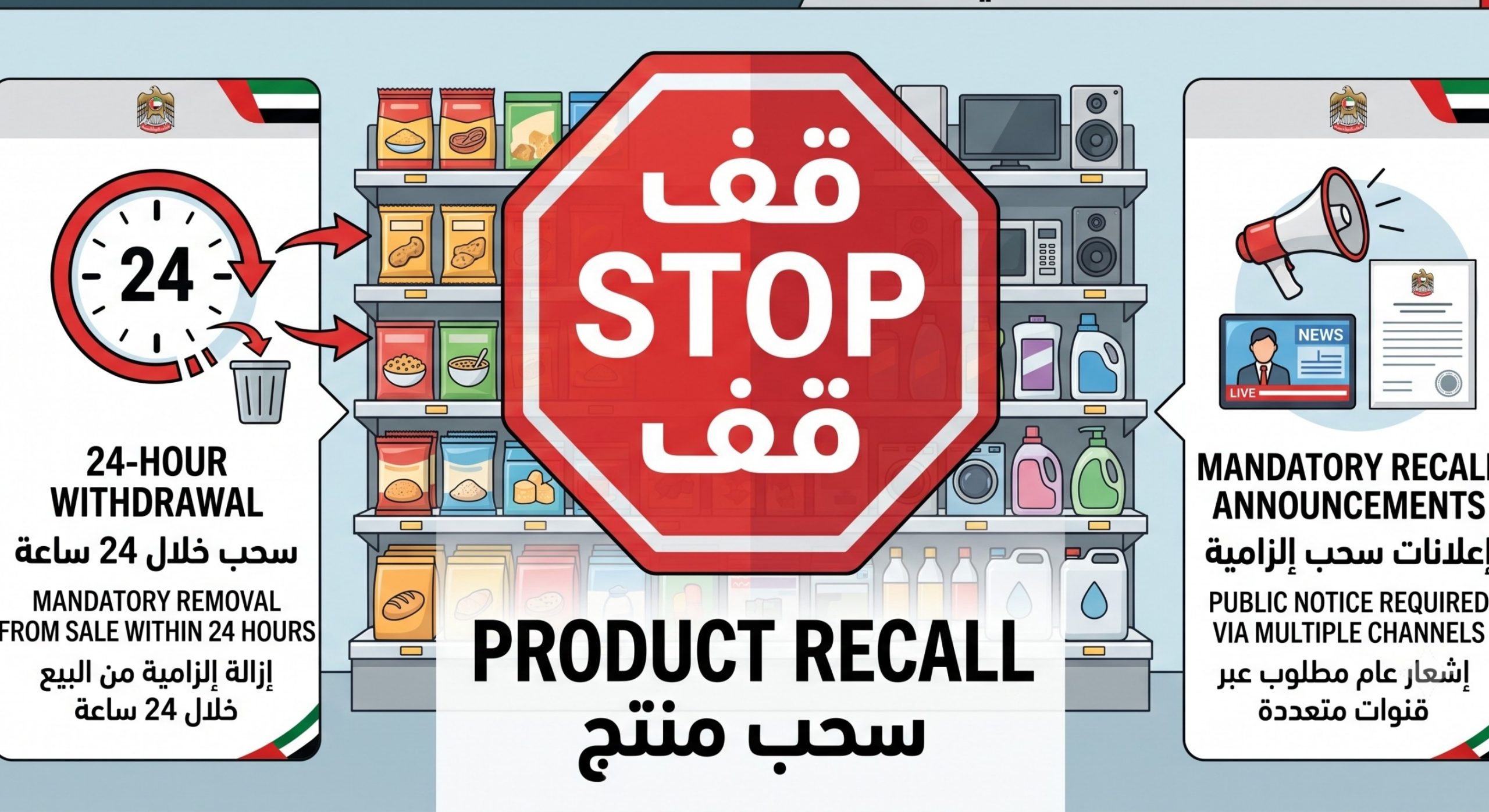
Once counterfeit, spoiled, or fake goods are identified, suppliers are immediately required to cease all sales and distribution.
Within twenty-four hours of receiving the regulatory notice, suppliers must withdraw the affected products from markets and warehouses, notify all retailers and distributors, recover the goods from circulation, and provide documentary evidence demonstrating compliance with the withdrawal process.
Simultaneously, regulators may seize the goods, prohibit any further dealings, and publicly warn consumers against purchasing or using the products.
Mandatory Public Recall Announcements
The Executive Regulation imposes extensive public notification obligations on suppliers.
Recall announcements must generally be issued within forty-eight hours through media channels specified by the authorities, including printed publications, television, radio, electronic platforms, and other communication channels.
Each announcement must contain comprehensive product information, including:
- the supplier’s contact details;
- the trademark;
- product type and model;
- country of origin;
- refund procedures;
- withdrawal locations; and
- recall deadlines.
- Significantly, every announcement must appear in both Arabic and English, ensuring accessibility for the UAE’s diverse population.
Regulatory Oversight of Product Recalls
Suppliers must submit detailed reports within five working days after commencing product withdrawals.
These reports must specify the quantities of affected products held by the supplier, products distributed to the market, quantities recovered, their value, and refunds made to consumers.
The Ministry may require additional documents, periodic reporting, or other measures necessary to supervise the recall process.
Where suppliers fail to conduct recalls within the prescribed period, the Ministry or competent authority may undertake the withdrawal directly and recover all associated costs from the supplier.
Flexible Disposal Mechanisms
Unlike previous legislation that primarily focused on destruction, the new Regulation introduces more flexible disposal options.
Subject to regulatory approval, counterfeit goods may, in appropriate circumstances, be:
- recycled;
- repurposed for lawful use; or
- returned to their country of origin or export.
However, these alternatives are permitted only where they do not infringe intellectual property rights, compromise public safety, or create environmental risks. All counterfeit trademarks must be removed before any lawful reuse is authorized.
This approach reflects the UAE’s increasing emphasis on sustainability and the circular economy.
Return to Country of Origin
Where no destruction order has yet been issued, suppliers may be required to return counterfeit goods to the country of origin or export within thirty days at their own expense.
If suppliers fail to do so, the Ministry or competent authority may return or destroy the goods while recovering all related expenses from the supplier.
Strict Controls Governing Destruction
Where destruction becomes necessary, the Regulation imposes strict procedural safeguards.
Destruction may only occur following either:
- a court judgment; or
- a decision issued by the Higher Committee.
Destruction must render the goods permanently unusable while ensuring that no environmental or health risks arise from the disposal process. The process should generally be completed within fifteen working days following the relevant judicial or administrative decision.
Detailed destruction reports must be prepared documenting the quantities destroyed, destruction methods, costs incurred, and other relevant information.
Increased Liability for Dealers
The Regulation introduces significant administrative exposure for dealers who knowingly participate in commercial fraud.
Administrative fines may be imposed where dealers knew, or should reasonably have known, that counterfeit goods were harmful or fraudulent, particularly where the products involve:
- pharmaceuticals;
- agricultural products;
- organic food;
- misleading advertising;
- intentional resale of counterfeit goods; or
- unlawful commercial exploitation of counterfeit products.
The inclusion of a “should have known” standard reflects the legislature’s intention to require businesses to exercise a higher degree of commercial diligence.
Formal Settlement Procedures
The Executive Regulation also establishes a structured settlement mechanism.
Violators may apply for settlement within ten working days after notification of the violation. The competent authority must determine the application within fifteen working days, while any rejection may itself be challenged through an internal grievance process.
Settlement is available only where the violation resulted from error or negligence rather than deliberate misconduct. Repeat offenders who have previously been fined during the preceding twelve months are ineligible.
Importantly, settlement does not erase the violation itself and does not exempt the violator from civil liability towards injured parties.
Practical Implications for Businesses
Businesses operating within the UAE should carefully review their compliance programmes in light of the new Executive Regulation.
Importers, manufacturers, distributors, retailers, logistics providers, and brand owners should establish robust product traceability systems, strengthen quality assurance procedures, maintain comprehensive records, and prepare internal recall protocols capable of complying with the strict statutory deadlines.
Particular attention should also be given to supplier due diligence, contractual allocation of recall responsibilities, crisis management planning, and employee training to reduce the risk of regulatory action.
Conclusion
Cabinet Decision No. (107) of 2026 represents one of the UAE’s most comprehensive regulatory developments in the field of commercial fraud prevention. By establishing detailed inspection procedures, mandatory recall mechanisms, coordinated enforcement powers, structured settlement procedures, and environmentally responsible disposal options, the Regulation significantly strengthens the UAE’s consumer protection framework.
Beyond combating counterfeit products, the Regulation reinforces the UAE’s commitment to market transparency, fair competition, public health, environmental sustainability, and investor confidence. Businesses operating within the UAE should proactively review their compliance frameworks to ensure full alignment with the new regulatory requirements, thereby minimizing legal risk while supporting the integrity and competitiveness of the UAE marketplace.
Authors:

Talk to a lawyer about your situation. KH Legal’s team in Dubai advises businesses and individuals across the UAE. Call +971 4 427 0845 or message us on WhatsApp for a confidential consultation.