



The Dubai Court of Cassation has delivered an important judgment addressing the rights of bank customers whose accounts are frozen pursuant to anti-money laundering investigations and the corresponding obligations of banks to comply with directives issued by the Central Bank of the UAE. In Commercial Cassation No. 1479 of 2026, decided on 22 July 2026, the Court examined whether a bank was liable to pay market-rate returns on funds frozen under Central Bank instructions and whether statutory default interest could subsequently be awarded on those accrued returns. The judgment provides significant guidance on the legal status of frozen bank accounts, the binding nature of Central Bank directives, and the prohibition against compound interest under the UAE Commercial Transactions Law.
Background of the Dispute
The dispute arose after the first claimant maintained three bank accounts with Emirates NBD, one in his personal capacity and two on behalf of companies wholly owned by him. In 2017, approximately AED 24 million was deposited into those accounts through manager’s cheques arising from commercial transactions.

Subsequently, the Public Prosecution issued an order freezing the funds as part of criminal investigations involving the first claimant. Acting upon the Public Prosecution’s order, the Central Bank instructed the bank to freeze the balances, transfer the funds into suspense accounts, calculate returns at the prevailing market rate, and prohibit any withdrawals without the approval of the Central Bank.
The criminal proceedings ultimately concluded with the acquittal of the account holder. Following the acquittal, the Public Prosecution instructed the Central Bank to lift the freeze, allowing the account holders to recover their funds.
Although the principal amount of AED 24 million was released, the bank declined to pay the market-rate returns that had accrued during the freezing period. Consequently, the account holders commenced legal proceedings seeking payment of those returns together with legal interest.
Proceedings Before the Lower Courts
The Court of First Instance dismissed the claim. On appeal, however, the Court of Appeal appointed a panel of banking experts to examine the dispute.
After reviewing the Central Bank’s directives and calculating the applicable market-rate return, the experts concluded that the claimants were entitled to AED 3,483,847.31.
The Court of Appeal accepted the expert report and ordered the bank to pay the calculated return together with legal interest at 5% per annum from the date of judicial demand until full payment.
The bank challenged that judgment before the Dubai Court of Cassation.
Whether the Central Bank’s Instructions Created an Enforceable Obligation
The bank argued that no legal or contractual basis existed requiring payment of any return on frozen current accounts.
It maintained that neither the account opening documentation nor applicable legislation imposed any obligation to pay interest. According to the bank, the Central Bank’s correspondence merely constituted an internal administrative instruction that could not independently create civil rights in favour of customers. The bank further contended that a later Central Bank letter omitted any reference to calculating market-rate returns, thereby indicating that the earlier instruction had been withdrawn.
The Court rejected these arguments.
Binding Nature of Central Bank Instructions
The Court undertook a detailed analysis of the UAE anti-money laundering framework, including Federal Decree-Law No. (20) of 2018 concerning Anti-Money Laundering and Combating the Financing of Terrorism, together with the legislative framework governing the Central Bank and licensed financial institutions.
The Court emphasized that the Central Bank exercises statutory supervisory authority over all licensed financial institutions operating within the UAE. Instructions, directives, and circulars issued pursuant to its legislative powers constitute mandatory regulatory rules that banks are legally obliged to implement. Such directives form part of the UAE’s financial public order and cannot be overridden by private contractual arrangements or banking practice.
Accordingly, where the Central Bank specifically instructed the bank to transfer the frozen balances into suspense accounts earning returns at the prevailing market rate, compliance with that instruction became a legal obligation rather than a discretionary banking practice.
The Effect of Freezing Customer Funds
A central issue before the Court concerned the legal consequences of freezing bank accounts.
The bank argued that frozen funds could not generate returns because neither the customer nor the bank could freely deal with the balances during the freezing period. The Court disagreed.
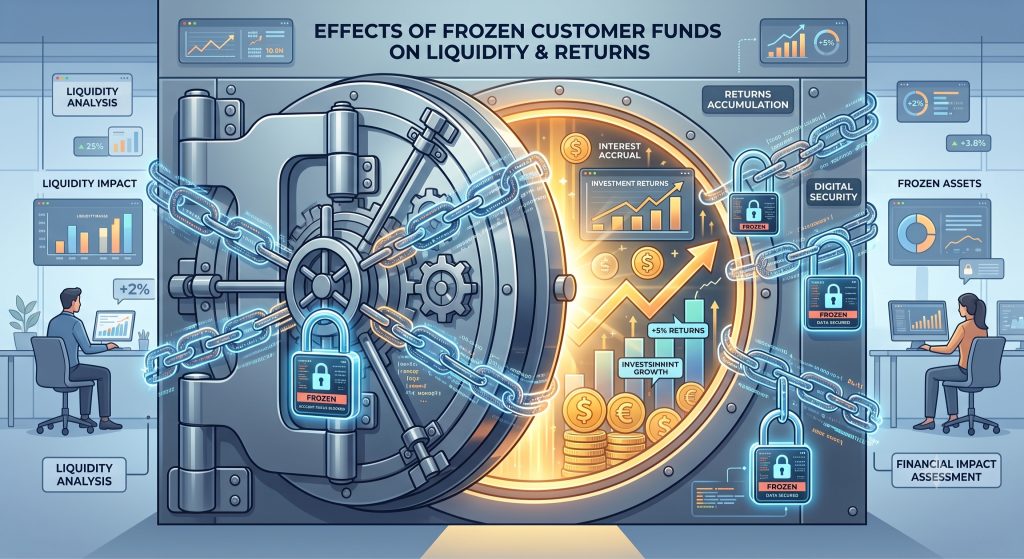
It explained that freezing, attachment, or precautionary seizure merely restricts the customer’s ability to withdraw or dispose of funds. Such measures do not remove the funds from the bank’s financial patrimony or possession. Deposited funds remain part of the bank’s assets and continue to represent accounting liabilities owed to customers rather than physically segregated cash held separately for each account holder.
Consequently, the Court recognised that the bank continues to benefit from the liquidity represented by customer deposits throughout the freezing period unless evidence demonstrates otherwise.
Importantly, the bank failed to establish that the frozen balances had been segregated from its available liquidity or that it had been unable to benefit from those funds during the period of the freeze.
Reliance on Expert Evidence
The Court reaffirmed established principles governing judicial expert reports.
It reiterated that expert reports constitute evidential material falling within the discretion of the trial court. Where an expert report is comprehensive, technically sound, and supported by the documentary evidence, the court is entitled to rely upon it without addressing every contrary argument advanced by the parties.
The expert committee calculated the return based upon the prevailing market rate throughout the actual freezing period in accordance with the Central Bank’s instruction of 7 December 2017. The Court found those calculations legally and technically sound and therefore upheld the award of AED 3,483,847.31.
Later Central Bank Correspondence Did Not Cancel Earlier Instructions
The bank also relied upon a subsequent Central Bank letter issued in November 2018 that omitted any reference to market-rate returns.
The Court held that the mere omission of earlier wording does not constitute an express or implied revocation of the previous instruction. Since the later correspondence did not expressly withdraw or amend the original directive, the earlier instruction requiring market-rate returns remained fully effective throughout the freezing period.
Seven-Day Freeze Limitation Did Not Apply
Another significant issue concerned the duration of the freeze.
The bank argued that any return should, at most, be limited to the seven working days mentioned in earlier Central Bank circulars governing freezes imposed directly by the Central Bank.
The Court distinguished the present case.
It explained that the initial freezing order originated from the Public Prosecution pursuant to anti-money laundering legislation rather than from the Central Bank itself. The Central Bank merely implemented that judicial instruction within its statutory supervisory functions.
Accordingly, the seven-day limitation applicable to regulatory freezes ordered directly by the Central Bank did not govern judicial freezing orders issued by prosecutorial authorities.
The Prohibition on Compound Interest
While the Court upheld the customers’ entitlement to the accrued market-rate return, it reached a different conclusion regarding the additional award of legal interest made by the Court of Appeal.
The Court carefully examined Articles 72, 73, 84, 86, and particularly Article 88 of Federal Decree-Law No. (50) of 2022 issuing the Commercial Transactions Law.
Article 88 expressly prohibits the recovery of compound interest, namely interest calculated upon previously accrued interest, whether characterised as compensatory or default interest.
The Court observed that the AED 3,483,847.31 awarded to the claimants did not represent the principal frozen funds but rather the accrued market-rate return itself.
Accordingly, the Court of Appeal’s subsequent award of 5% legal interest upon that accrued return effectively amounted to awarding interest upon interest, contrary to the mandatory prohibition contained in Article 88 of the Commercial Transactions Law.
The Final Judgment
The Dubai Court of Cassation partially allowed the bank’s appeal.
The Court upheld the customers’ entitlement to AED 3,483,847.31 representing the market-rate return accrued during the freezing period pursuant to the Central Bank’s mandatory instruction.
However, it set aside the portion of the judgment awarding an additional 5% annual legal interest from the date of judicial demand, holding that such an award violated the statutory prohibition against compound interest.
The Court therefore maintained the principal award while refusing any further interest upon the accrued return.
Practical Implications
This judgment carries significant implications for banks, financial institutions, and account holders throughout the UAE.
First, it confirms that regulatory instructions issued by the Central Bank pursuant to its supervisory powers are legally binding and form part of the UAE’s financial public order. Banks cannot disregard such instructions or rely upon contractual provisions to avoid compliance.
Secondly, the judgment clarifies that freezing customer accounts does not necessarily deprive customers of financial returns where the Central Bank specifically directs that market-rate returns should accrue.
Thirdly, the decision recognises the economic reality of banking operations by acknowledging that deposited funds generally remain part of a bank’s available liquidity notwithstanding restrictions imposed upon customers’ access.
Finally, the judgment reinforces the absolute statutory prohibition against compound interest under Article 88 of the Commercial Transactions Law. Even where a party is entitled to accrued interest or market-rate returns, courts cannot award further interest upon that accrued amount.
Conclusion
Commercial Cassation No. 1479 of 2026 is a landmark decision clarifying the interaction between banking regulation, anti-money laundering enforcement, and commercial obligations under UAE law. The judgment confirms that banks must strictly comply with mandatory Central Bank instructions concerning frozen accounts, including directions requiring market-rate returns where applicable. At the same time, it reaffirms the legislature’s firm prohibition on compound interest by preventing the award of legal interest on amounts that themselves represent accrued interest.
The decision provides valuable guidance for financial institutions, legal practitioners, and commercial parties by balancing regulatory compliance, customer rights, and the integrity of the UAE’s commercial and banking legal framework.
Authors:


Talk to a lawyer about your situation. KH Legal’s team in Dubai advises businesses and individuals across the UAE. Call +971 4 427 0845 or message us on WhatsApp for a confidential consultation.