



Introduction
In a significant judgment for intellectual property and commercial litigation in the UAE, the Abu Dhabi Court of Cassation has reaffirmed the legal distinction between material damages and moral (non-pecuniary) damages in trademark infringement disputes involving corporate entities. The judgment provides important guidance on the scope of compensation available to companies whose registered trademarks have been infringed and clarifies the evidentiary burden required to recover damages for lost profits.
The Court’s decision reinforces established principles under the UAE Civil Transactions Law by confirming that while companies are fully entitled to seek injunctive relief and compensation for proven economic losses, they cannot ordinarily recover compensation for moral damages because such damages are inherently linked to the personal feelings and dignity of natural persons.
Background of the Dispute
The claimant was a well-established manufacturer and distributor of food products and confectionery that owned a registered trademark recognized throughout the region. Its products were marketed using distinctive packaging, colours, and branding, which had acquired significant commercial goodwill over time.
The claimant had previously maintained a commercial relationship with the defendant during 2023, supplying its products through export transactions. Owing to that prior business relationship, the defendant had detailed knowledge of the claimant’s products, packaging, and registered trademark.
Subsequently, the claimant discovered that the defendant had begun manufacturing and marketing products bearing a remarkably similar trade name and packaging. The imitation allegedly involved changing only the first letter of the claimant’s trademark while preserving nearly every other visual element of the product, including the colour scheme, packaging design, and overall commercial appearance. The counterfeit products were marketed both through traditional channels and the defendant’s official online store, creating a substantial likelihood of consumer confusion.
The issue came to light after a customer complained about the poor quality of a product believed to originate from the claimant. Upon examining the purchase documentation, the claimant discovered that the product had actually been supplied by the defendant under the deceptively similar branding.
The claimant further asserted that despite filing a complaint before the Ministry of Economy and notwithstanding official warnings issued to the defendant to cease selling the infringing products, the defendant continued marketing the products within the UAE and abroad throughout 2024 and 2025, thereby generating profits from the unlawful exploitation of the claimant’s registered trademark.
Claims Before the Court
The claimant commenced proceedings before the Abu Dhabi Commercial Court seeking several remedies, including:
- An order permanently restraining the defendant from using the infringing trademark and trade name;
- Confiscation and destruction of all infringing products, advertisements, labels, packaging materials, and promotional materials;
- AED 500,000 as compensation for lost profits;
- AED 200,000 as compensation for material, moral, and reputational damages.
The claim was founded upon trademark infringement, unfair competition, and the unlawful exploitation of the claimant’s commercial reputation.
Judgment of the Court of First Instance
The Court of First Instance ruled substantially in favour of the claimant.
It ordered the defendant to:
- Immediately cease infringing the claimant’s trademark;
- Remove, confiscate, and destroy all infringing materials;
- Pay AED 200,000 for lost profits;
- Pay AED 200,000 for moral damages.
The Court therefore recognised both the commercial losses suffered by the claimant and the alleged injury to its commercial reputation.
Appeal Before the Court of Appeal
The defendant appealed.
The Court of Appeal partially overturned the first-instance judgment.
While maintaining the injunction prohibiting further trademark infringement, the appellate court:
- Set aside the award of AED 200,000 for moral damages;
- Reduced compensation for lost profits from AED 200,000 to AED 49,270, treating the amount as compensation for proven material damage and lost profits.
The claimant subsequently challenged this decision before the Abu Dhabi Court of Cassation.
Issues Before the Court of Cassation
The Court of Cassation was required to determine two principal legal questions:
- Whether a corporate entity can recover compensation for moral damages arising from trademark infringement.
- Whether the Court of Appeal acted lawfully in reducing the compensation awarded for lost profits.
These issues carry substantial importance for intellectual property litigation involving commercial entities.
Can a Company Recover Moral Damages?
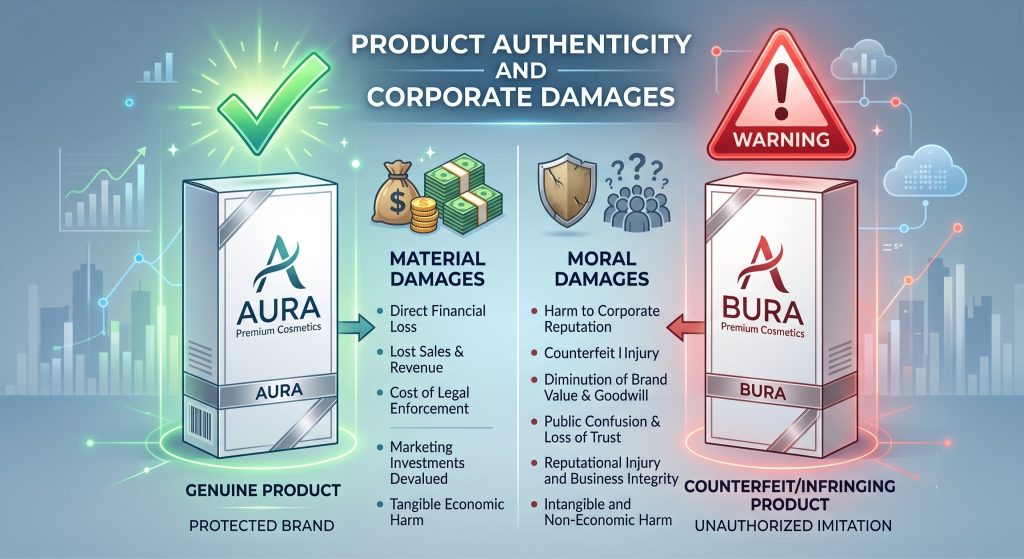
The claimant argued that the defendant’s conduct had severely damaged its commercial reputation, goodwill, and market standing.
It contended that:
- its registered trademark enjoyed substantial recognition;
- consumers had become confused by the defendant’s imitation;
- inferior counterfeit products damaged its reputation;
- the defendant intentionally exploited its commercial identity.
Accordingly, the claimant maintained that moral damages should not be restricted solely to natural persons because commercial reputation constitutes a legally protected interest deserving compensation.
The Court’s Legal Reasoning
The Court rejected this argument.
Relying principally upon Article 293(1) of the UAE Civil Transactions Law, the Court explained that moral damage concerns injuries affecting:
- personal freedom;
- honour;
- dignity;
- reputation;
- social standing;
- emotional suffering.
These forms of injury are intrinsically connected to human personality.
The Court emphasised that a juridical person possesses legal personality only within the limits prescribed by law and does not possess emotions, feelings, or personal dignity capable of suffering moral injury.
Accordingly, a company cannot ordinarily claim compensation for moral damages merely because its commercial reputation has been affected.
The Court further observed that no individual owner or shareholder had alleged that he personally suffered reputational or emotional harm. Rather, the claim was advanced solely by the corporate entity itself.
Consequently, the Court concluded that compensation for moral damage was legally unavailable.
Material Damages and Lost Profits
The claimant also challenged the reduction of compensation for lost profits from AED 200,000 to AED 49,270.
The Court rejected this argument as well.
It reaffirmed the established principle that assessment of damages is a discretionary function entrusted to the trial court.
Compensation is intended to restore actual loss rather than enrich the injured party.
The Court found that:
- the claimant had not established every element of the alleged economic loss;
- the evidence presented did not justify the higher amount originally awarded;
- the Court of Appeal was entitled to reassess the evidence and determine a lower figure that accurately reflected the proven loss.
Because the Court of Appeal exercised its discretion within the bounds of the law, the Court of Cassation declined to interfere.
Final Decision
The Abu Dhabi Court of Cassation dismissed the appeal in its entirety.
The Court therefore confirmed:
- the permanent injunction restraining trademark infringement;
- confiscation and destruction of infringing materials;
- compensation limited to AED 49,270 for proven material damages and lost profits;
- rejection of the claim for AED 200,000 in moral damages.
The claimant was also ordered to pay the costs of the cassation proceedings and AED 1,000 towards the defendant’s legal fees, together with forfeiture of the security deposit lodged for the appeal.
Practical Implications for Businesses
This judgment provides valuable guidance for trademark owners operating in the UAE.
First, the decision confirms that UAE courts continue to provide robust injunctive protection against trademark infringement. Rights holders can obtain orders prohibiting further infringement and requiring the destruction of counterfeit products and marketing materials.
Secondly, businesses seeking monetary compensation must carefully document their financial losses. Claims for lost profits should be supported by accounting records, sales data, expert reports, and evidence directly linking the infringement to measurable economic damage.
Thirdly, companies should recognise that damage to corporate reputation alone will not automatically justify an award of moral damages. Unless legislation expressly provides otherwise, compensation for moral injury remains confined to interests closely associated with natural persons.
Finally, the judgment highlights the importance of prompt enforcement of intellectual property rights. The claimant had previously reported the infringement to the Ministry of Economy, and although administrative action was taken, continued civil litigation remained necessary to secure injunctive relief and financial compensation.
Conclusion
The Abu Dhabi Court of Cassation’s Judgment No. 561/2026 represents an important clarification of UAE law governing trademark infringement and damages. The Court reaffirmed that while registered trademark owners enjoy strong judicial protection against infringement, compensation must be firmly grounded in proven economic loss. Moral damages, absent exceptional statutory authority or personal injury to an individual, remain unavailable to corporate entities because companies cannot suffer emotional or personal harm in the legal sense.
For businesses engaged in intellectual property disputes, the decision underscores two essential litigation principles: first, preserve comprehensive evidence of actual financial loss; and second, understand that protecting commercial reputation through injunctions and recovery of quantifiable damages is more likely to succeed than pursuing compensation for non-pecuniary harm. This judgment therefore strengthens legal certainty in the UAE’s intellectual property regime by balancing effective trademark enforcement with principled limitations on compensatory awards.
Authors:
Talk to a lawyer about your situation. KH Legal’s team in Dubai advises businesses and individuals across the UAE. Call +971 4 427 0845 or message us on WhatsApp for a confidential consultation.